IELTS vs TOEFL vs Duolingo English Test: Which One in 2026?
A clear, up-to-date comparison of IELTS, TOEFL, and the Duolingo English Test for 2026, so you can pick the exam that actually fits your situation.

Direct Answer
Which English test should I take in 2026?
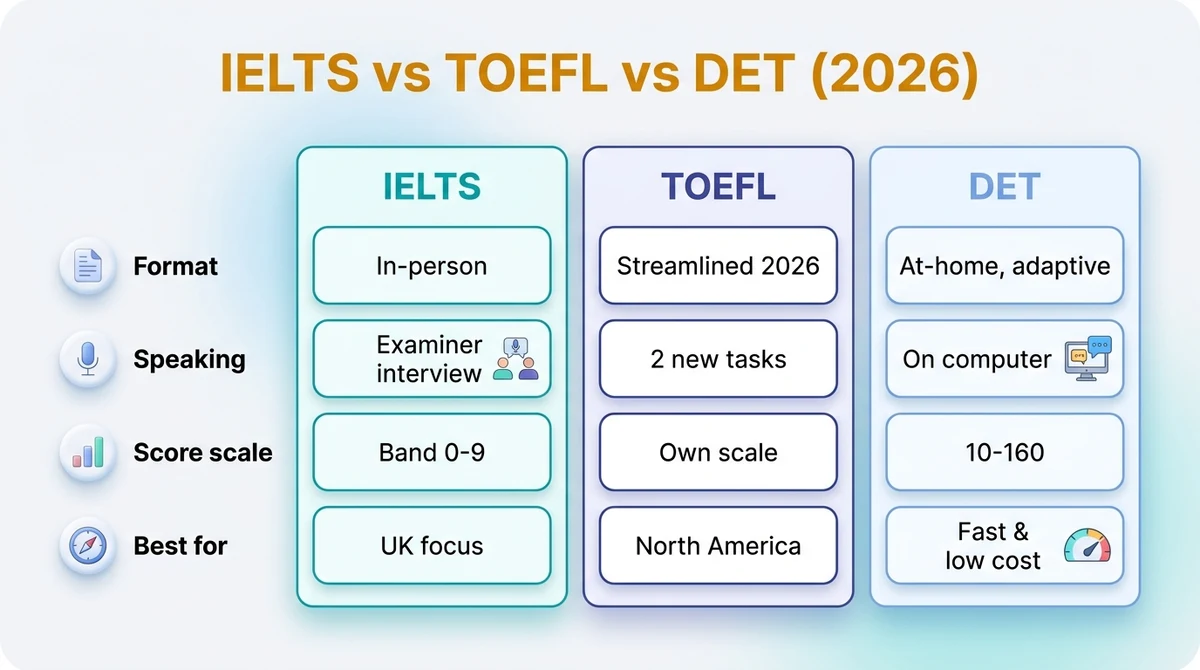
There is no single best test, only the best test for your situation. The Duolingo English Test is fastest, cheapest, and taken at home. TOEFL is widely accepted and newly streamlined for 2026, strong in North America. IELTS is the long-standing standard, especially in the UK, with a face-to-face speaking interview.
Always confirm the exact score your target schools require on the specific test.
Picking an English test can feel like the hardest part of the whole process, before you have even started studying. Three big options, three different formats, and a lot of conflicting advice online. Let's cut through it.
Here is an honest, up-to-date comparison of the three tests most universities accept in 2026, so you can choose the one that actually fits you.
The quick answer
There is no single best test. There is a best test for your situation. But here is the short version.
The Duolingo English Test, or DET, is the fastest, cheapest, and most convenient. You take it at home. TOEFL is widely accepted, newly streamlined for 2026, and strong in North America. IELTS is the long-standing standard, especially in the UK, and it is available on paper or computer with a real human examiner for the speaking section.
Now let's break down what actually separates them.
Format and experience
Duolingo English Test
The DET is fully online and adaptive. The questions adjust to your level as you go. You take it from home, on your own computer, and it is typically the shortest of the three. If the idea of a testing center gives you anxiety, this is the relaxed option, and that comfort is a real advantage for a lot of people.
TOEFL in 2026
The TOEFL got a major redesign in 2026. The Speaking section in particular was rebuilt around two new tasks, Listen and Repeat and Take an Interview, and trimmed to about eight minutes with no prep time. The whole test is more streamlined than the version older guides describe, so make sure any prep you use is current.
IELTS
IELTS is the most traditional of the three. Its Speaking section is a face-to-face interview of about eleven to fourteen minutes, split into three parts, and scored on four criteria: fluency and coherence, lexical resource, grammatical range and accuracy, and pronunciation. Some people love the human interaction. Others find it nerve-wracking. Know which one you are before you book.
Scoring: they do not speak the same language
This trips people up constantly. The three tests use completely different scales.
The DET gives an overall score plus subscores on a 10 to 160 scale, in steps of five. IELTS uses band scores from 0 to 9, in half-band increments. TOEFL uses its own section and total scores.
The practical takeaway: do not try to convert between them in your head. Instead, check the specific score your target university asks for on the specific test. That is the only number that matters, and a rough conversion can send you chasing the wrong target.
Acceptance: who takes what
Acceptance used to be the DET's weak spot. Not anymore. As of 2026, the Duolingo English Test is accepted by thousands of institutions worldwide, including a large majority of top-ranked US universities and every Ivy League school. IELTS and TOEFL remain broadly accepted globally, with IELTS especially strong in the UK, Australia, and Canada.
The golden rule: before you choose, check your target schools' admissions pages directly. Acceptance and minimum scores are set by each institution, and they are the final word, not any blog, including this one.
Cost and convenience
If budget and speed are your priorities, the DET usually wins. It is typically the most affordable and the fastest to book and complete, with results returned quickly. TOEFL and IELTS generally cost more and often involve a test center, though both now offer at-home or computer-based options in many places. For a student applying to several schools on a deadline, that difference in speed and price can genuinely matter.
What the tests have in common
It is easy to fixate on the differences, but the similarities matter just as much for how you prepare. All three tests are trying to measure the same underlying thing: whether you can genuinely use English in an academic setting. They just probe it from different angles. That means the core skills, listening accuracy, clear pronunciation, a solid vocabulary, and the ability to speak smoothly under mild pressure, help you on every one of them.
This is reassuring if you are undecided. You do not have to lock in a test before you start improving. Spend your first few weeks building those transferable fundamentals, and you will be in a stronger position no matter which test you eventually book. The test-specific tactics, the exact task formats and timing, are a thin layer you add on top of real ability, not a substitute for it.
How to actually make the decision
If you are still stuck, turn the choice into a short checklist rather than an endless comparison. First, list every school or program you are applying to and write down which tests they accept and the minimum scores they want. That single step often eliminates an option or two immediately, which is a relief when you have been going in circles.
Second, be honest about how you perform. If a live human interview makes you seize up, IELTS speaking may cost you points that have nothing to do with your English. If you thrive on convenience and hate test centers, the at-home DET plays to your strengths. Third, factor in budget and timeline, because a cheaper, faster test can matter a great deal when you are applying to several schools at once.
Put those three inputs together and the right answer usually becomes obvious. There is rarely a perfect choice, only the one that best fits your list, your temperament, and your deadline. Decide, then stop second-guessing and start practicing, because a good score on any accepted test beats endless deliberation over which is theoretically best.
A quick word on retakes
One more thing worth knowing before you commit: none of these tests are one-shot. If your first score comes back lower than you need, you can prepare and take the test again, and many students do exactly that. Knowing this takes a lot of pressure off the initial choice. You are picking a starting point, not signing a lifelong contract.
That said, retakes cost time and money, so the goal is still to be genuinely ready the first time. Treat your first attempt as a real attempt, not a free trial. Build the fundamentals, practice under realistic conditions, and confirm you are consistently hitting your target score in practice before you book. Do that, and the test becomes a formality that confirms what you already know, rather than a nervous gamble on an unfamiliar format.
So which one should you take?
Here is how I would think about it.
Choose the DET if you want convenience, lower cost, and an at-home experience, and your target schools accept it. Choose the TOEFL if you are applying primarily in North America and like the newer, streamlined 2026 format. Choose IELTS if your target countries lean toward it, hello UK, or you actually prefer speaking to a real human examiner.
Whichever you pick, the prep fundamentals are the same: clear pronunciation, real fluency, and calm, natural speaking under pressure. Those skills transfer across all three tests, so time spent building them is never wasted, even if you switch tests later.
Pick the test that fits your life, then put your energy into speaking well. That is the part that actually moves your score, and it is the part you have the most control over.
Can I compare scores across the three tests?
Not directly. Each uses its own scale, so check the exact score your target institution requires on the specific test you plan to take rather than trying to convert between them.
Continue Within This Cluster
Cluster guide
Duolingo English Test Practice Guide for March 2026This guide explains duolingo english test practice with current March 2026 context, targeted practice ideas, and direct next steps inside EnglishPrepAI.
Keep Practicing
Official and Authoritative Sources
Share this article
Copy the canonical link or continue with the next guided practice step.
FAQ
Which English test is easiest?
There is no universally easiest test. The best choice depends on your target schools, your budget, and whether you prefer testing at home or in person.
Is the Duolingo English Test widely accepted in 2026?
Yes. It is accepted by thousands of institutions worldwide, including most top-ranked US universities and all Ivy League schools. Always confirm with your specific target school.
What score scales do the tests use?
The Duolingo English Test uses a 10 to 160 scale, IELTS uses bands from 0 to 9, and TOEFL uses its own section and total scores.
How is IELTS speaking different?
IELTS speaking is a face-to-face interview of about eleven to fourteen minutes in three parts, scored on fluency, vocabulary, grammar, and pronunciation.
Which test is cheapest and fastest?
Usually the Duolingo English Test. It is typically the most affordable, is taken at home, and returns results quickly.
Related Articles

Duolingo English Test Practice Guide for March 2026
This guide explains duolingo english test practice with current March 2026 context, targeted practice ideas, and direct next steps inside EnglishPrepAI.

Duolingo English Test vs TOEFL in March 2026
This guide explains duolingo english test vs toefl with current March 2026 context, targeted practice ideas, and direct next steps inside EnglishPrepAI.

DET "Write About the Photo": How It's Scored and How to Prep
This guide explains duolingo english test write about the photo with current March 2026 context, targeted practice ideas, and direct next steps inside EnglishPrepAI.