New: Collective Reports Turn Your Practice Into a CEFR Score
Collective Reports pull all your practice into one CEFR-aligned score, so you finally know where your English stands and what to do next.

Direct Answer
What is a Collective Report?
A Collective Report combines all of your practice into one overall level aligned to the CEFR, the international standard for language ability from A1 to C2. It shows your overall level, a breakdown by skill, and a concrete next step, so you finally know how strong your English is in terms the whole world recognizes.
Anchoring to the CEFR means your progress translates directly to universities and employers.
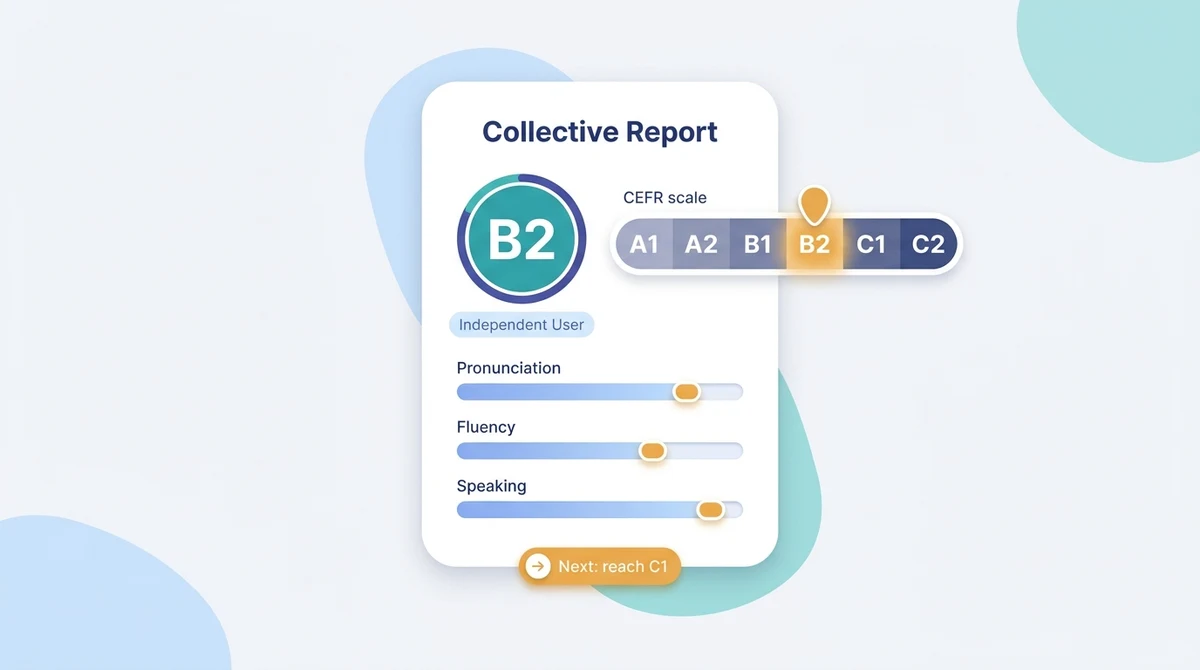
We have just shipped a feature we are genuinely excited about, and it answers the single question almost every learner eventually asks: okay, but how good is my English actually?
Say hello to Collective Reports.
What is new
Until now, your practice lived in pieces. A pronunciation session here, a speaking drill there, a vocabulary streak somewhere else. All useful, but scattered. It was hard to step back and see the whole picture, and even harder to answer that nagging "how am I doing overall" question.
Collective Reports pulls all of that together into one clear report that tells you where your English stands overall. And it does it against a standard the whole world already uses: the CEFR.
Wait, what is the CEFR?
Great question, and it is the reason this feature matters.
The Common European Framework of Reference for Languages, or CEFR, is the international standard for describing language ability. It was developed by the Council of Europe, and it organizes proficiency into six levels across three broad bands.
The six levels
A1 and A2 are the Basic User band. You can handle simple, everyday phrases and basic exchanges. B1 and B2 are the Independent User band. You can hold your own in most situations, from travel to work conversations. C1 and C2 are the Proficient User band. You can operate fluently and precisely, close to a native speaker.
Every level is defined by can-do descriptors, practical statements about what you can actually do with the language, not abstract grades. The CEFR has been translated into more than forty languages and is used by schools, employers, and testing systems worldwide. In other words, when a report says you are B2, that means something everyone recognizes.
Why we aligned Collective Reports to the CEFR
We could have invented our own scoring scale. Lots of apps do. But a made-up number, "you are a 78," does not tell you anything about the real world.
A CEFR level does. It maps to what universities ask for, what employers understand, and how the major English exams are calibrated. Anchoring your report to the CEFR means your progress here translates directly to the world outside the app. That is the difference between a score that feels good for a moment and a level you can actually put on an application.
What your Collective Report shows you
Open a report and you will see three things.
First, your overall CEFR level, based on your combined practice. This is the headline answer to "how good is my English right now."
Second, a breakdown by skill, so you can see where you are stronger and where to focus. Maybe your pronunciation is ahead of your fluency, or your speaking confidence is lagging your vocabulary. The breakdown makes that visible instead of leaving it to guesswork.
Third, what to do next. This is the part that turns "you are a B1" into a concrete plan for reaching B2. A score you cannot act on is just trivia. A CEFR level with a next step is a map.
Why a shared standard beats a private score
There is a quiet psychology to progress. When you cannot measure something, it is easy to feel like you are running in place. You practice, you sort of improve, but you have no anchor, so motivation drifts.
A CEFR level fixes that. Suddenly your effort has a destination. You are not just "getting better at English," you are working from B1 toward B2, and you can see the gap shrinking. That clarity is worth a surprising amount, because it turns a vague, endless goal into a series of concrete, reachable steps.
It also keeps you honest. If a whole month of casual practice does not move your level, the report tells you, gently but clearly, that it is time to change how you practice. Feedback like that is uncomfortable and incredibly useful.
How to see your report
If you have already been practicing, you may have a report waiting. Head to your Reports page to check. If you would like a fresh baseline, take a quick CEFR assessment, and then keep practicing. Your report updates as you go, so you can watch yourself climb from one level toward the next.
How to use your level instead of just admiring it
Getting a CEFR level feels good, but the real value is in what you do next. A level is a starting point for a plan, not a trophy to frame. So once you know where you stand, translate it into a target and a direction rather than just noting the letter and moving on.
Say your report puts you at B1 with a next step of reaching B2. That gap has a shape. B2 speakers can hold a fluent, spontaneous conversation, argue a point of view, and handle unexpected turns without falling apart. Compare that to what you can do now, and the specific weaknesses jump out. Maybe your vocabulary is solid but your fluency stalls under pressure, or your pronunciation is holding back otherwise strong answers. The per-skill breakdown in your report points right at it.
From there, the move is simple: pick the lagging skill and give it the bulk of your practice time for a few weeks, then re-check your report. If the level nudges up, keep going. If it does not, change your approach. That loop, measure, focus, re-measure, is how a level becomes a lever instead of just a label.
Why measuring progress protects your motivation
There is a quiet reason this matters beyond strategy. Language learning is long, and the daily changes are so small they are invisible. Without a way to measure, it is easy to feel like you are working hard and going nowhere, and that feeling is what makes people quit right before things click.
A CEFR-aligned report fights that. It zooms out far enough to show movement you cannot feel day to day. Seeing your marker sit a little closer to the next level, even after a slow month, is often the difference between staying with it and drifting away. Progress you can see is progress you will keep chasing, and that persistence, more than any single study trick, is what eventually gets you fluent.
What the levels do not measure
One honest note, so you use your report wisely. A CEFR level is a broad summary, not a verdict on you as a person or even a complete picture of your English. It captures general proficiency well, but it will not reflect how much your confidence has grown, how much more you understand in films, or how much easier ordering food in English has become. Those wins are real even when the letter has not changed yet.
So treat the level as one useful signal among several, not the only scoreboard that counts. Let it guide where you focus and reassure you that you are moving, but do not let a slow month convince you that nothing is happening. Underneath a stable level, plenty is usually shifting, and those quiet gains are often what tip you into the next level when you least expect it.
This is just the start
Collective Reports is the foundation for a lot of what is coming next: clearer goals, smarter recommendations, and a real sense of momentum. For now, we hope it answers that nagging question with something honest and useful. Not a made-up number, but a level the whole world understands.
Go take a look. We think seeing your progress on a real scale is going to feel pretty good, and we think it will make your next month of practice a lot more focused than your last one.
Does my Collective Report update over time?
Yes. As you keep practicing, your report reflects your latest ability, so you can watch yourself climb from one CEFR level toward the next.
Continue Within This Cluster
Cluster guide
Best AI Tools for Speaking Practice in March 2026This guide explains ai tools for speaking practice with current March 2026 context, targeted practice ideas, and direct next steps inside EnglishPrepAI.
Keep Practicing
Official and Authoritative Sources
Share this article
Copy the canonical link or continue with the next guided practice step.
FAQ
What is a CEFR level?
It is an internationally recognized measure of language ability, from A1 for beginners to C2 for near-native speakers, developed by the Council of Europe.
What do the six CEFR levels mean?
A1 and A2 are Basic User, B1 and B2 are Independent User, and C1 and C2 are Proficient User. Each level is defined by practical can-do statements.
How is my Collective Report calculated?
It combines your practice across skills into one overall CEFR-aligned level, with a per-skill breakdown for pronunciation, fluency, and speaking.
Why align to the CEFR instead of a custom score?
Because a CEFR level means something in the real world. It maps to what universities ask for and what employers understand, so your progress here translates outside the app.
How do I see my report?
Open the Reports page. If you have been practicing, a report may be waiting, or you can take a quick CEFR assessment for a fresh baseline.
Related Articles

Best AI Tools for Speaking Practice in March 2026
This guide explains ai tools for speaking practice with current March 2026 context, targeted practice ideas, and direct next steps inside EnglishPrepAI.

Can AI Improve English Speaking in March 2026?
This guide explains can ai improve english speaking with current March 2026 context, targeted practice ideas, and direct next steps inside EnglishPrepAI.
How AI Scores English Speaking: What Learners Should Check
This guide explains how ai scores english speaking with current March 2026 context, targeted practice ideas, and direct next steps inside EnglishPrepAI.