Pronunciation Studio: Real-Time AI Feedback on Every Sound
Pronunciation Studio gives you instant, sound-by-sound feedback on your English pronunciation. Here is how it works and why it speeds up progress.
Direct Answer
What does Pronunciation Studio do?
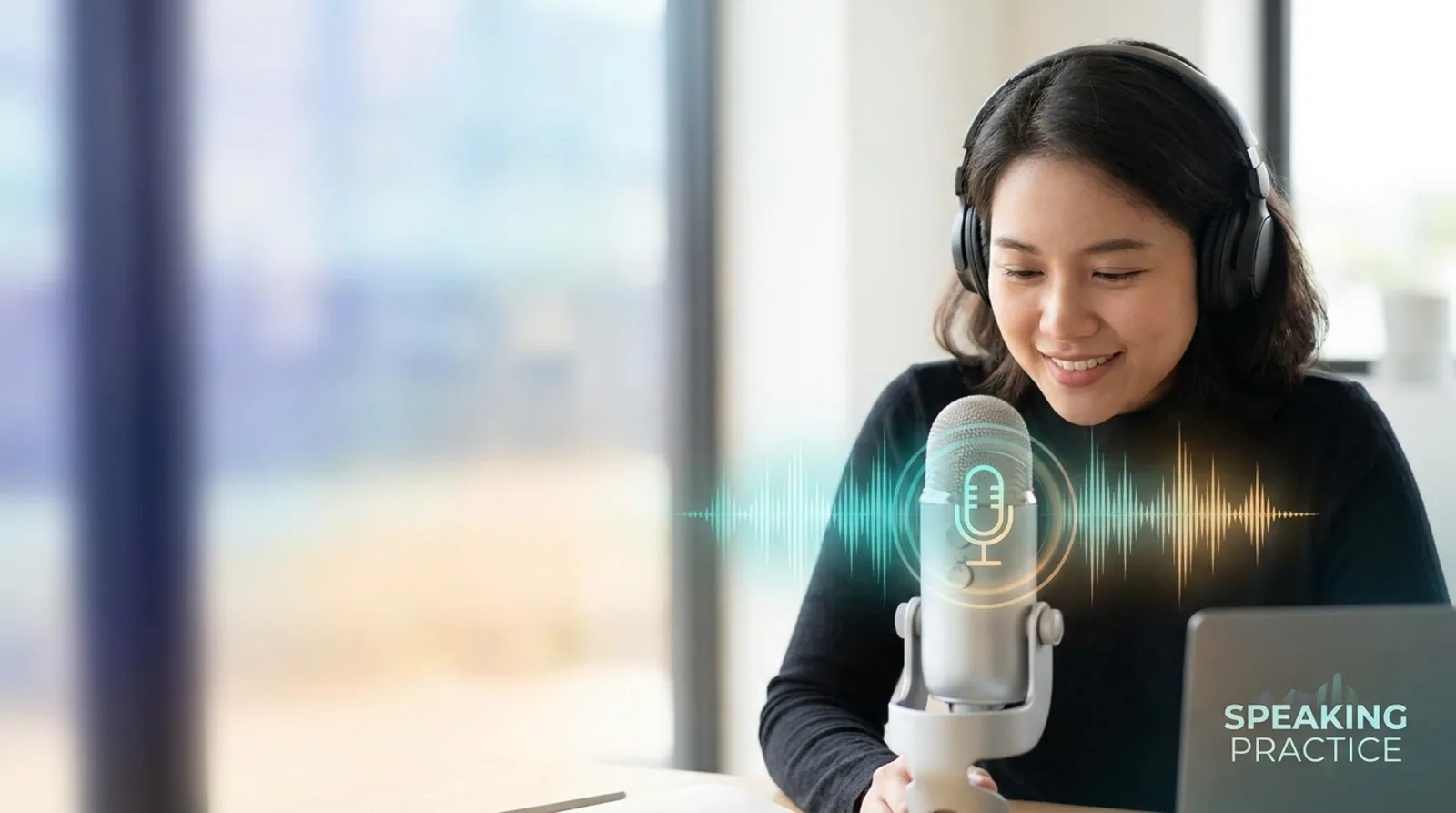
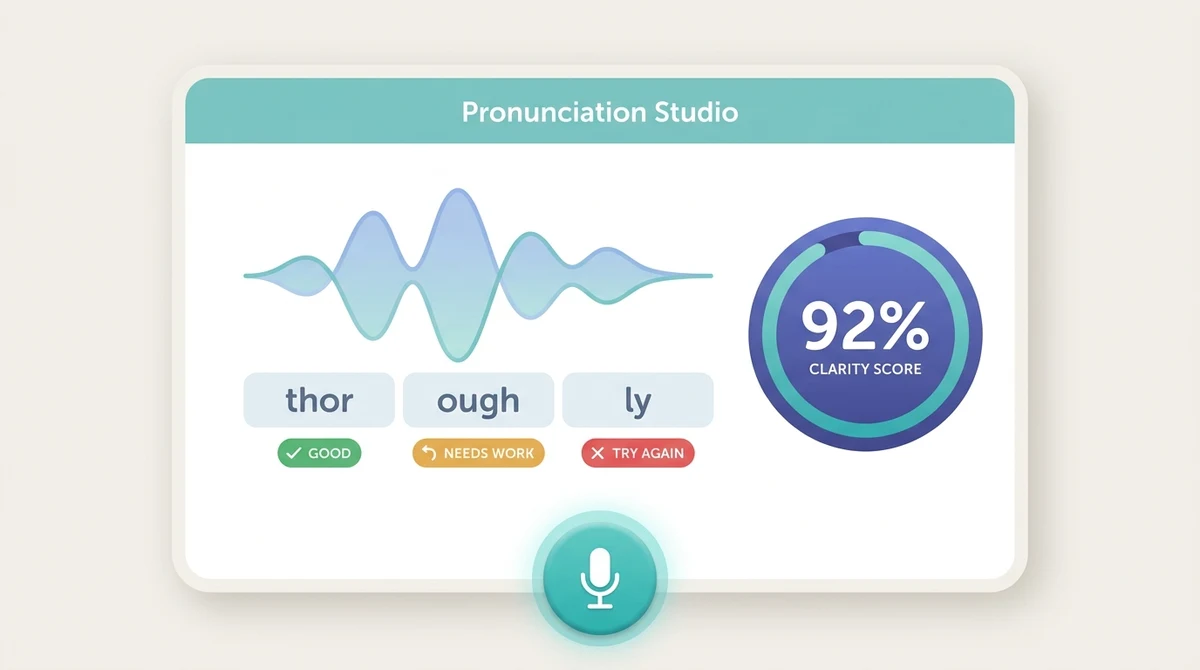
Pronunciation Studio listens to you speak and returns sound-by-sound feedback within a couple of seconds, showing exactly which syllables landed cleanly and which drifted. It also gives an overall clarity score, so you can practice the same word repeatedly and watch your pronunciation improve in real time.
Instant, specific feedback closes the learning loop while the sound is still fresh in your mouth.
Here is the frustrating thing about improving your pronunciation on your own: you cannot hear your own mistakes. Your brain knows what you meant to say, so it quietly corrects the audio in your head. That is why you can practice a word fifty times and still say it wrong the fifty-first.
That gap is exactly what Pronunciation Studio was built to close.
What Pronunciation Studio actually does
You speak. It listens. And within a second or two, it shows you, sound by sound, where your pronunciation landed and where it drifted.
No waiting for a tutor. No guessing whether that "th" came out right. Just immediate, specific feedback that treats your voice like data instead of a vibe.
It scores the sounds, not just the word
A lot of apps give you a single green checkmark or a red X. That tells you something was wrong but not what. Pronunciation Studio breaks your speech down to the individual sound level, so you can see whether the problem was a vowel that was too flat, a consonant you swallowed, or stress that landed on the wrong syllable.
That precision matters, because you cannot fix what you cannot locate. "Say it better" is not a useful instruction. "The stress belongs on the second syllable, and your final consonant disappeared" is something you can act on immediately.
It never gets tired of you
A human tutor has a schedule, a rate, and a limit to how many times they will cheerfully listen to you attempt "thoroughly" before lunch. The AI does not. You can repeat the same tricky word twenty times in a row at six in the morning and get the same patient, consistent feedback every single time.
For most learners, that repetition without judgment is the whole game. A lot of pronunciation trouble is not a knowledge problem, it is a reps problem, and reps are exactly what an always-available tool is good at.
Why real-time feedback changes how fast you improve
There is a simple reason instant feedback works so well: it closes the loop while the sound is still fresh in your mouth.
When you say a word wrong and only find out a week later, the learning is gone. You cannot connect the correction to the physical feeling of saying it. When the feedback comes back in two seconds, you can adjust right now, try again, and lock in the corrected version while your mouth still remembers what it just did.
That tight loop, say, see, adjust, repeat, is how pronunciation actually rewires. It is the same principle that makes a mirror useful when you are learning a physical skill. The faster you can see the gap between what you did and what you meant to do, the faster you close it.
Where it fits in your routine
Pronunciation Studio is not meant to replace real conversation. It is the practice room before the stage. A few ways learners use it:
Warm-ups
Five minutes of targeted sound drills before a lesson or a real conversation gets your mouth moving and your ear switched on. You walk into the harder task already warm instead of fumbling the first few sentences.
Test prep
Cleaning up clarity ahead of the TOEFL Speaking or IELTS speaking sections pays off directly, because pronunciation is a scored criterion. On the new TOEFL Listen and Repeat task especially, clean reproduction is the entire point, and Pronunciation Studio is built for exactly that kind of rapid rep.
Problem sounds
Every learner has two or three sounds their first language does not include. Hunt those down and drill them until they stop being scary. Once your hardest sounds stop tripping you up, your overall speech sounds dramatically more confident, even if nothing else changed.
What good feedback actually looks like
Not all feedback is created equal, and it is worth knowing what to look for. Weak feedback is vague and global: a single score, a thumbs up, a "close enough." It might feel encouraging, but it does not tell you what to change, so you repeat the same mistake with more confidence. Good feedback is specific and local. It points at a sound, a syllable, or a stress pattern and says, here is the gap, right here.
Pronunciation Studio is built around that second kind. When it flags a syllable, you know precisely where to aim your next attempt. That specificity is what lets you improve in minutes rather than months, because you are never guessing at the target. Guessing is slow and demoralizing; aiming at a clearly marked spot is fast and oddly satisfying.
There is also a motivational side to this. Specific feedback makes progress visible. When you can watch a syllable move from red to amber to green over a handful of attempts, you get a small, real hit of momentum. That visible progress is what keeps people practicing, and practice, repeated often, is the only thing that actually changes how you sound.
Building a two-week clarity streak
If you want a concrete way to use the tool, try a two-week clarity streak. Each day, pick three words you find difficult, run them through Pronunciation Studio, and drill each one until it reaches a clarity score you are happy with. That is maybe five minutes of work, which is short enough that you will actually do it.
Keep a short list of the words you conquer. By the end of two weeks you will have deliberately fixed around forty tricky words, and more importantly, you will have trained the habit of checking rather than guessing. That habit outlasts any single word. It turns pronunciation from a source of quiet anxiety into something you know how to improve on demand, which is a genuinely different way to feel about speaking English.
Why this beats passively listening
A lot of learners try to fix pronunciation by consuming more English, more shows, more podcasts, more videos. Input is valuable, but on its own it is passive. You can listen to thousands of hours of English and still mispronounce common words, because listening trains your ear, not your mouth. Pronunciation is a production skill, and production skills only improve when you produce.
That is the real shift Pronunciation Studio encourages: from passively absorbing English to actively making it, with immediate correction. Ten minutes of speaking with feedback will move your pronunciation more than an hour of watching something with subtitles. The watching is enjoyable and useful for other reasons, but if clearer speech is the goal, you have to open your mouth and get told, precisely, how it went.
Try it on your worst word
Here is my challenge for you. Think of the one English word you always dodge, the one you rephrase your whole sentence to avoid. Open Pronunciation Studio, say it, and see exactly what has been going wrong all this time.
It is a weirdly satisfying moment. Suddenly the thing you have been guessing at for years becomes something you can see and fix. And once you have fixed one avoided word, you start to trust that the rest are fixable too, which is honestly half the battle with pronunciation.
The bigger point is this: pronunciation improvement is not really about talent. It is about getting clear, immediate information about what your mouth is doing, then adjusting and repeating. That used to require a patient teacher sitting next to you. Now it can happen any time you have a few quiet minutes and something to say. That is the shift Pronunciation Studio is built around, and it is why a little practice, done often, adds up faster than you would expect.
Does Pronunciation Studio replace speaking with real people?
No. Think of it as the practice room before the stage. It cleans up your sounds so real conversations feel easier, but you still need live speaking practice too.
Continue Within This Cluster
Cluster guide
Best AI Tools for Speaking Practice in March 2026This guide explains ai tools for speaking practice with current March 2026 context, targeted practice ideas, and direct next steps inside EnglishPrepAI.
Keep Practicing
Official and Authoritative Sources
Share this article
Copy the canonical link or continue with the next guided practice step.
FAQ
How fast is the feedback?
Near-instant. You get a sound-by-sound breakdown within a couple of seconds of finishing a word or sentence.
Do I need a special microphone?
No. A standard laptop or phone microphone works fine for accurate feedback.
Can it help with test prep?
Yes. Pronunciation is a scored criterion on IELTS and matters heavily for the new TOEFL speaking tasks, so clearer sounds directly help your score.
How often should I use it?
Short daily sessions beat occasional long ones. Even five focused minutes a day builds clearer pronunciation over a few weeks.
What should I practice first?
Start with the one English word you always avoid. Say it, see the breakdown, and drill the specific sound that has been going wrong.
Related Articles

Best AI Tools for Speaking Practice in March 2026
This guide explains ai tools for speaking practice with current March 2026 context, targeted practice ideas, and direct next steps inside EnglishPrepAI.

Can AI Improve English Speaking in March 2026?
This guide explains can ai improve english speaking with current March 2026 context, targeted practice ideas, and direct next steps inside EnglishPrepAI.
How AI Scores English Speaking: What Learners Should Check
This guide explains how ai scores english speaking with current March 2026 context, targeted practice ideas, and direct next steps inside EnglishPrepAI.