7 Daily Habits That Quietly Fix Your English Pronunciation
Seven small, low-pressure daily habits that quietly improve your English pronunciation. Pick two to start; you do not need all seven at once.

Direct Answer
What is the fastest way to improve English pronunciation daily?
Practice a little every day instead of cramming. Warm up out loud, shadow one line of audio, record yourself, and target one specific sound at a time. Short, frequent reps build the physical muscle of pronunciation far more reliably than occasional long study sessions you dread and skip.
Pronunciation is a physical skill, so consistency beats intensity.
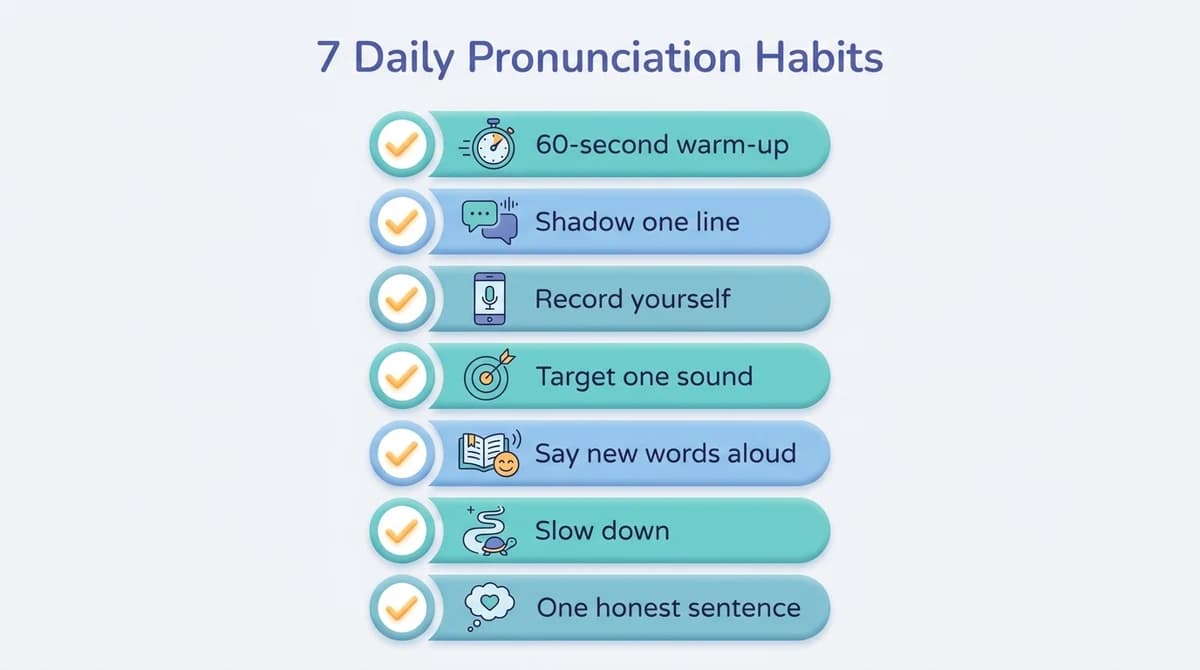
Most people think fixing their pronunciation means signing up for a big, intimidating course. It does not. The learners who sound clearest usually are not the ones who studied hardest for one weekend. They are the ones who did something small every single day.
Here are seven habits that fit into a normal life and add up faster than you would expect. Pick two to start. You do not need all seven at once.
1. Do a 60-second warm-up out loud
Before your first call, coffee, or commute, read one sentence out loud, slowly and clearly. That is it. The point is not the sentence. It is teaching your mouth that English is a physical activity, not just something that happens in your head. A cold start makes your first few sentences mushy; a quick warm-up fixes that.
2. Shadow one line of audio
Find any short clip, a podcast, a show, a voice note, and repeat one line right after the speaker, matching their rhythm and melody. This is called shadowing, and it is one of the most efficient pronunciation tools that exists because it trains your ear and your mouth at the same time. You are not translating or analyzing. You are copying the music of natural English.
3. Record yourself once a day
Here is the uncomfortable one. Record yourself saying two or three sentences and play it back. You will hear things you never notice while speaking, a dropped ending, a flat vowel, a rushed word. That gap between what you think you sound like and what you actually sound like is where all the growth hides.
If listening to yourself makes you cringe, good. That cringe is you finally hearing what everyone else hears, and that is the first step to fixing it. Nobody enjoys this habit at first, and almost everybody who sticks with it improves.
4. Target one sound, not all of them
Trying to fix "my accent" is too big to act on. Trying to fix your "th" this week is a real task. Pick one sound your native language does not have and give it a little attention for a few days before moving on.
Not sure which sounds are costing you the most? A quick session in Pronunciation Studio will flag your weakest ones by name, so you are not guessing. Once you know your two or three problem sounds, you can attack them one at a time instead of feeling vaguely unhappy about everything.
5. Say new words out loud the first time you meet them
When you learn a word by reading it, your brain invents a pronunciation, and it is often wrong. Break the habit. The first time you meet a useful new word, say it out loud and check it. Learning it silently means learning it wrong, and unlearning a wrong pronunciation is much harder than learning the right one from the start.
6. Slow down on purpose
Speed is not fluency. A lot of learners rush because they think fast sounds fluent, but rushing smears your sounds together and makes you harder to understand. Practice saying things a notch slower than feels natural. Clear-and-slightly-slow beats fast-and-mushy every time, and it gives your mouth room to actually form each sound.
7. End the day with one honest sentence
At night, say one full sentence about your day, out loud, as clearly as you can. It bookends your day with English and turns practice into a routine instead of a chore. Small, but it compounds, and it means you have spoken English deliberately at least twice today.
How to stack these habits so they actually stick
Knowing seven habits is easy. Doing them is the hard part, and the trick is not willpower, it is attachment. New habits stick when you anchor them to something you already do without thinking. This is sometimes called habit stacking, and it works because the existing routine becomes the reminder, so you do not have to rely on motivation that comes and goes.
So instead of vaguely vowing to practice pronunciation more, attach each habit to a specific trigger. After I pour my morning coffee, I read one sentence out loud. While I walk to the bus, I shadow one line from a podcast. After I brush my teeth at night, I say one sentence about my day. The action is tiny, and the trigger is already built into your life, so you barely have to remember it.
Start with just two stacks, not seven. If you try to install all seven habits on day one, you will feel overwhelmed by day three and quit. Two small habits, attached to two solid daily triggers, are far more likely to survive. Once those two feel automatic, which usually takes a week or two, add a third. Slow is fine. Slow is how habits become permanent instead of becoming another thing you feel guilty about abandoning.
What to do when you miss a day
You will miss days. Everyone does, and it is not a problem unless you let it become one. The learners who succeed are not the ones with perfect streaks; they are the ones who restart quickly after breaking a streak. Missing Monday only matters if it also takes out Tuesday and Wednesday.
So give yourself a simple rule: never miss twice. If you skip a day, just do the tiniest possible version the next day, one sentence out loud, and you are back. Perfection is not the goal here. Showing up more often than not, over months, is what quietly rebuilds how you sound, and it is far more forgiving than most people assume.
Why small habits beat big study sessions
It is tempting to think a three-hour weekend session equals six thirty-minute sessions. For pronunciation, it does not, and the reason is physical. Your mouth is learning new movements, and new movements are wired in through frequent, spaced repetition, not through occasional marathons. A little every day gives your brain many chances to consolidate the pattern while it rests in between.
There is a practical benefit too. Small daily habits survive a busy life; big study blocks are the first thing to get cancelled when work or family gets hectic. A habit you can do in two minutes on your worst day is a habit that lasts. And lasting is the entire point, because pronunciation does not improve in a week. It improves over months of small, boring, reliable reps that you barely notice adding up until one day someone tells you how clear you sound.
The real secret: consistency beats intensity
None of these habits are impressive on their own. That is the point. Pronunciation improves through frequent, low-pressure reps, not through occasional heroic study sessions you dread and skip.
Stack two of these onto things you already do daily, and let them run for a month. You will hear the difference before anyone tells you about it. And because each habit is tiny, you are far more likely to actually keep going, which is the only thing that really matters.
When you are ready to add structure, the AI Tutor can turn these habits into a tracked routine, so you can see your streak and your progress instead of wondering whether it is working. But you do not need any of that to start. You just need one sentence, out loud, today.
Which habit should I start with?
Start by recording yourself. Hearing the gap between what you think you sound like and what you actually sound like reveals your specific problems, so the rest of your practice targets the right things.
Continue Within This Cluster
Cluster guide
How to Improve English Fluency FastThis guide explains how to improve english fluency fast with current March 2026 context, targeted practice ideas, and direct next steps inside EnglishPrepAI.
Keep Practicing
Official and Authoritative Sources
Share this article
Copy the canonical link or continue with the next guided practice step.
FAQ
How long until I hear a difference?
Most learners notice clearer sounds within two to four weeks of daily practice, even at just a few minutes a day.
Is a little practice every day really better than one long session?
Yes. Pronunciation is a physical skill, and frequent short reps build it more reliably than occasional long ones.
What is shadowing?
Shadowing means repeating a line of audio right after the speaker, matching their rhythm and melody. It trains your ear and mouth at the same time.
Why does recording myself help so much?
Your brain hides your mistakes while you speak. A recording lets you hear what everyone else hears, which is the first step to fixing it.
Do I need to fix my whole accent?
No. Target one sound at a time. Small, specific goals are far more achievable and add up faster than trying to fix everything at once.
Related Articles

How to Improve English Fluency Fast
This guide explains how to improve english fluency fast with current March 2026 context, targeted practice ideas, and direct next steps inside EnglishPrepAI.
Good Speaking Rate: Words Per Minute Explained
This guide explains good speaking rate words per minute with current March 2026 context, targeted practice ideas, and direct next steps inside EnglishPrepAI.

Best Pronunciation Exercises for English Learners
This guide explains pronunciation exercises for english learners with current March 2026 context, targeted practice ideas, and direct next steps inside EnglishPrepAI.