How to Speak English More Fluently: The Shadowing Method
A step-by-step guide to the shadowing method, one of the most efficient ways to build real English fluency, plus what natural pace actually means.

Direct Answer
What is the shadowing method for English fluency?
Shadowing means listening to a native speaker and repeating what they say almost simultaneously, trailing just a beat behind like a shadow. You copy the sound, rhythm, and melody of natural English in real time, which trains listening, pronunciation, and speaking rhythm together in a single rep.
Fusing those three skills in one exercise is why shadowing is so efficient.
Fluency is the goal everyone wants and almost nobody knows how to practice. You cannot exactly study fluency the way you study grammar. So most people just hope it shows up.
There is a better way, and it has been used by interpreters and serious language learners for decades. It is called shadowing, and once you understand it, it is almost embarrassingly simple.
What shadowing actually is
Shadowing means listening to a native speaker and repeating what they say almost simultaneously, trailing just a beat behind, like a shadow. You are not translating. You are not analyzing. You are copying the sound, the rhythm, and the melody of natural English in real time.
Why does it work so well? Because it trains the three things fluency is actually made of, listening, pronunciation, and speaking rhythm, all at once, in the same rep. Most practice trains these separately. Shadowing fuses them, which is why ten minutes of it can feel more productive than an hour of isolated drills.
Why fluency is not about speed
Before we get to the how, let's kill a myth: fluency is not talking fast.
The major exams are clear about this. On the IELTS Speaking test, Fluency and Coherence is one of four scored criteria, and it measures how smoothly your ideas connect, not how quickly you fire off words. Speaking fast with constant hesitations and restarts scores worse than speaking at a calm, steady pace.
For reference, comfortable, natural English conversation tends to land somewhere around 140 to 160 words per minute, brisk enough to sound natural, relaxed enough to stay clear. If you are racing past that, you are probably sacrificing the clarity that fluency depends on. Shadowing helps here too, because you naturally absorb the speaker's pacing instead of inventing your own rushed one.
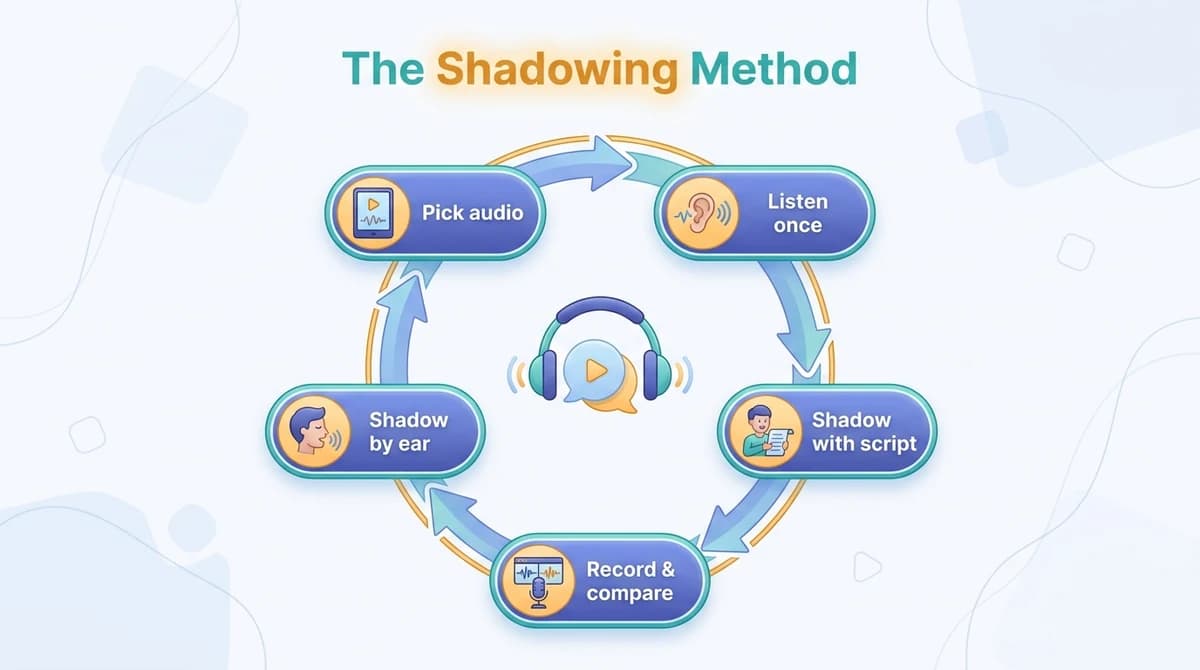
How to shadow, step by step
Here is the method. Start easy. You can make it harder as you improve.
Step 1: Pick the right audio
Choose a short clip, thirty to sixty seconds, of clear, natural English on a topic you find interesting. Podcasts, interviews, and audiobooks work great. Avoid anything too fast or too slangy at first, because you want to succeed at copying, not struggle to keep up.
Step 2: Listen once, fully
Play the clip once without speaking. Just take in the meaning, the rhythm, and where the speaker pauses. Get a feel for the music of it. This one quiet pass makes the shadowing that follows far easier.
Step 3: Shadow with the script
Now play it again and speak along, trailing a half-second behind, while reading the transcript if you have one. Do not stop to fix mistakes. Keep pace with the speaker even if you stumble. The goal is flow, not perfection. Stopping to correct every slip breaks the rhythm you are trying to build.
Step 4: Shadow without the script
Once you are comfortable, ditch the transcript and shadow by ear alone. This is where the real magic happens. You are now catching and reproducing English in real time, exactly like the Listen-and-Repeat style tasks demand. It is harder, and it is where the biggest gains hide.
Step 5: Record and compare
Finally, record yourself shadowing and play it back against the original. How close is your rhythm? Your stress? Your pauses? This comparison is where you spot what to fix, and where you will hear yourself getting closer week by week. Tools like Pronunciation Studio make this step fast by scoring your clarity automatically, so you are not straining to judge yourself.
How to fit it into your week
You do not need long sessions. Ten focused minutes of shadowing a day will move your fluency more than an hour of silent grammar review.
A simple rhythm works well. Pick one clip and shadow it all week, because repetition is a feature, not a bug. Spend the first couple of days shadowing with the script, the next few days shadowing by ear, and the last couple of days recording, comparing, and choosing next week's clip. Reusing one clip lets you feel real improvement instead of always starting from zero.
Common shadowing mistakes to avoid
Shadowing is simple, but a few common mistakes quietly blunt its effect, and knowing them saves you weeks. The first is choosing audio that is too hard. If you are struggling just to keep up with the words, you have no attention left for rhythm and pronunciation, which are the whole point. Drop to slower, clearer audio and build up. Success at an easy clip beats failure at an ambitious one, every time.
The second mistake is going silent. Some learners shadow in their heads because speaking out loud feels awkward, especially in shared spaces. But shadowing is a physical exercise for your mouth. If your lips are not moving and your voice is not producing sound, you are doing listening practice, not shadowing. Find a private moment and actually speak, even quietly.
The third mistake is chasing novelty. It feels productive to grab a new clip every day, but repetition is where the gains live. Shadowing one clip across a week lets you go from clumsy to smooth on that exact material, and that felt improvement is what teaches your mouth the patterns. Variety feels good in the moment; repetition is what actually works.
Where shadowing fits with your other practice
Shadowing is powerful, but it is one tool, not a whole plan. It builds rhythm, pronunciation, and listening, but it does not build the ability to generate your own ideas under pressure. So pair it with something that does, and you cover both halves of fluency.
A balanced week might look like this: shadow for ten minutes to sharpen your delivery, then spend another ten minutes on spontaneous speaking, talking about a random topic with no script. The first exercise makes your English sound better; the second makes it come faster. Together they cover both halves of fluency, how you sound and how quickly you can produce language, which is exactly the combination the speaking sections of every major exam reward.
How to pick audio that actually helps
Your choice of audio quietly decides how well shadowing works, so it is worth a little thought. Aim for speakers whose accent and pace you would be happy to sound like, because you are literally copying them. Clear, standard, moderately paced speech is ideal. Overly dramatic performances, heavy regional slang, and fast comedy banter are fun to listen to but frustrating to shadow.
Length matters too. A thirty to sixty second clip is long enough to contain real rhythm but short enough to repeat many times without losing focus. And pick topics you genuinely find interesting, because you are going to hear this clip a lot over a week, and boredom is the quiet killer of practice routines. If the content keeps your attention, you will come back to it, and coming back is the entire mechanism that makes shadowing pay off.
Give it two weeks
Shadowing feels strange for the first few days. You will trip over words and feel a beat behind. That is normal. That is your brain learning to process and produce English at the same time. Push through two weeks and something clicks: speaking starts to feel less like assembling a sentence and more like just talking.
That feeling is fluency. And now you know how to practice it. Keep a clip going, protect your ten minutes, and let the rhythm of natural English slowly become your own. Of all the habits you could build this month, this is the one most likely to make you sound noticeably more fluent by the end of it.
Does speaking faster make me more fluent?
No. Fluency is smooth, coherent speech, not speed. Comfortable English conversation sits around 140 to 160 words per minute, and racing past that usually hurts the clarity fluency depends on.
Continue Within This Cluster
Cluster guide
How to Improve English Fluency FastThis guide explains how to improve english fluency fast with current March 2026 context, targeted practice ideas, and direct next steps inside EnglishPrepAI.
Keep Practicing
Official and Authoritative Sources
Share this article
Copy the canonical link or continue with the next guided practice step.
FAQ
What is shadowing in language learning?
It is repeating a native speaker almost simultaneously, copying their rhythm and pronunciation to build fluency and clear speech.
How long until shadowing works?
Most learners feel a noticeable shift in fluency after about two weeks of daily ten-minute sessions.
What audio should I use?
Short clips of clear, natural English on a topic you enjoy, like podcasts, interviews, or audiobooks. Avoid anything too fast or slangy at first.
Is fluency the same as speaking quickly?
No. Fluency means speaking smoothly with natural pacing and without excessive hesitation. A calm, steady pace scores better than a rushed one.
How much should I shadow each day?
Ten focused minutes a day is plenty. Repetition of one clip across a week works better than a new clip every day.
Related Articles

How to Improve English Fluency Fast
This guide explains how to improve english fluency fast with current March 2026 context, targeted practice ideas, and direct next steps inside EnglishPrepAI.
Good Speaking Rate: Words Per Minute Explained
This guide explains good speaking rate words per minute with current March 2026 context, targeted practice ideas, and direct next steps inside EnglishPrepAI.

Best Pronunciation Exercises for English Learners
This guide explains pronunciation exercises for english learners with current March 2026 context, targeted practice ideas, and direct next steps inside EnglishPrepAI.