TOEFL Is Changing in 2026: What the New Speaking Section Really Means
ETS rebuilt the TOEFL Speaking section around two new tasks. Here is what changed and how to get ready for the 2026 format.

Direct Answer
What changed in the TOEFL 2026 Speaking section?
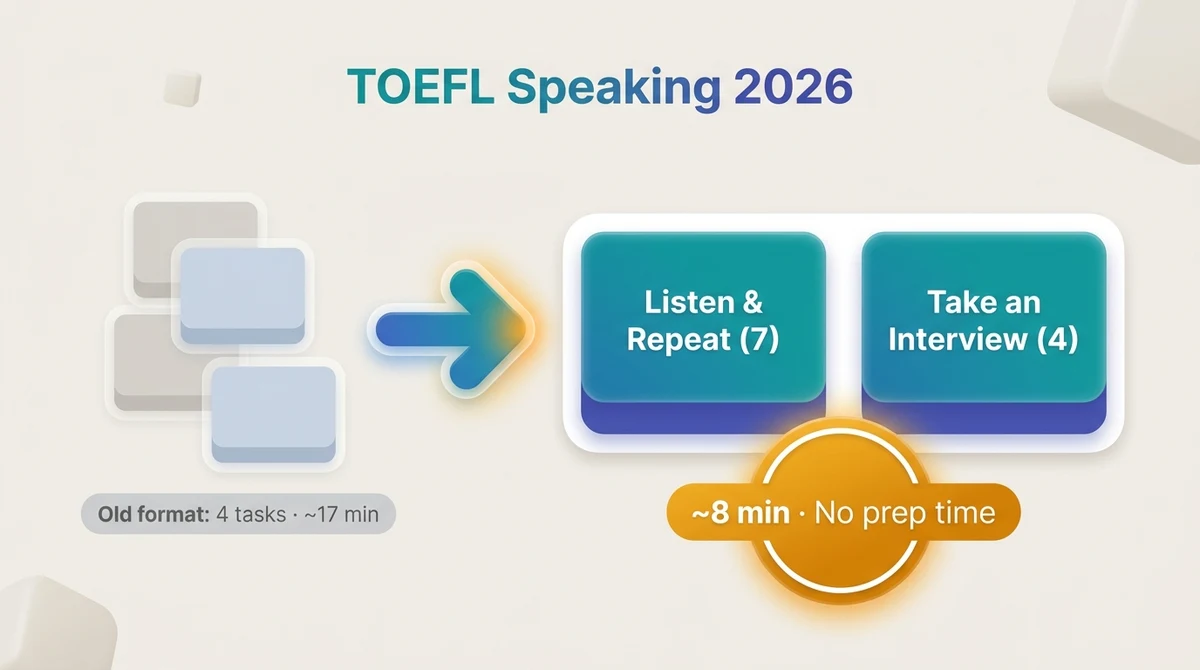
ETS replaced the four old speaking tasks with two new ones, Listen and Repeat and Take an Interview, and cut the section to about eight minutes. There are eleven questions total and no preparation time, so every response must be spontaneous and natural rather than scripted.
The redesign rewards real speaking skill and clear pronunciation instead of memorized templates.
If you have been prepping for the TOEFL with an old study guide, I have some news that might make you close the tab: the Speaking section you were studying for does not exist anymore.
ETS has rolled out the biggest redesign of the TOEFL iBT Speaking section in years, and it is not a small tweak. The whole thing has been rebuilt around two brand-new task types. Let's walk through what changed, why it matters, and how to stop practicing for a test that is no longer being given.
What actually changed in the 2026 Speaking section
Here is the short version. The old Speaking section had four tasks and ran about seventeen minutes. The 2026 version replaces all of that with two new tasks and clocks in at roughly eight minutes.
That is not a typo. The section is now about half as long, and the tasks are completely different. That single fact should reshape how you study, because the skills the test rewards have shifted underneath the same familiar name.
Task 1: Listen and Repeat
You hear a short sentence, and you say it back exactly as you heard it. There is no script on screen. You listen, and you repeat.
It sounds simple, but it is a sneaky test of two things at once: how well you catch spoken English, and how cleanly you can reproduce it. Your pronunciation, rhythm, and stress all show up here in a way they never did before. If you mishear a small function word, your repetition drifts, and the scoring notices.
Task 2: Take an Interview
The second task drops you into a simulated interview on a familiar, everyday topic. You respond to a series of prompts the way you would in a real conversation, with no essay-style templates required.
Across both tasks there are eleven questions in total: seven in Listen and Repeat and four in Take an Interview. The topics are meant to be approachable, so the challenge is not obscure vocabulary. The challenge is speaking naturally, on the spot, without freezing.
The change nobody is talking about: no prep time
Here is the part that trips people up. In the old format, you got a few seconds to plan before you spoke. In the 2026 tasks, that prep time is gone.
You listen, and you respond. Spontaneously. Naturally. In real time.
That is a big deal, because a lot of TOEFL prep from the last decade was built around memorized templates, those "There are two main reasons I believe this" openers. Those templates were a crutch for the old format. In the new one, they are dead weight. What the test now rewards is the ability to actually speak, clearly, smoothly, and off the cuff.
What this means for how you prepare
If the new section is about spontaneous, clear speech under zero prep time, then your practice has to change to match. Three shifts matter most.
Train your ear, not just your mouth
Listen and Repeat lives or dies on how accurately you hear English. Daily listening-and-repeating practice, even five minutes, builds the exact muscle the task measures. Start with slow, clear audio, then work up to faster, more natural speech. The goal is to catch the whole sentence on the first pass and give it back with the same melody.
Drop the templates, build real fluency
Instead of memorizing openers, practice talking about ordinary topics until the words come without effort. Pick a familiar subject, start speaking within three seconds, and keep going for thirty seconds without stopping. That reflex is exactly what Take an Interview measures, and it is trainable.
Fix pronunciation early
With rhythm and clarity now front and center, sloppy sounds cost you more than they used to. Identify the two or three sounds your first language does not have, and drill them until they stop being scary. Clear beats fancy every single time.
This is honestly where practicing with instant AI feedback shines. You can run unlimited listen-and-repeat reps and get scored on clarity the moment you finish, instead of waiting for a tutor's next opening. That tight loop of speak, see, adjust, and repeat is how pronunciation actually rewires.
Should you be worried?
Honestly? No. A shorter, more natural section is good news if you have been building real speaking skill instead of memorizing scripts. The people it hurts are the ones who were planning to fake their way through with templates.
Think about it from the test maker's side. A spontaneous interview and a repeat-what-you-hear task are much harder to game than a predictable prompt with prep time. That is the point. The 2026 format is trying to measure whether you can genuinely communicate, not whether you can recite a rehearsed paragraph.
So the winning strategy is refreshingly old-fashioned. Speak out loud every day. Listen actively. Record yourself and compare. Clean up your weakest sounds. Practice starting a sentence before you feel completely ready, because on test day you will not have time to feel ready.
How the new format rewards clarity over cleverness
It helps to understand the logic behind the redesign, because it tells you what to prioritize. The old format gave you prep time and predictable prompts, which meant a well-drilled student could lean on memorized structures and still score reasonably well. That rewarded preparation strategy almost as much as actual speaking ability. The 2026 tasks quietly close that loophole.
Listen and Repeat cannot really be gamed. Either you catch the sentence and reproduce its sounds and stress, or you do not. Take an Interview is similar: with no prep time and natural prompts, there is nowhere to hide a rehearsed paragraph. What surfaces instead is your genuine ability to understand and respond, which is exactly what a speaking test should measure.
For you, that is clarifying. It means the highest-value practice is also the most honest practice. You are not trying to outsmart the format; you are trying to become a clearer, more responsive speaker. Every minute you spend improving your listening accuracy, your pronunciation, and your ability to think out loud pays off directly on the test and in real conversations. That alignment between test skill and real skill is rare, and it is worth leaning into.
What to do with your old prep materials
If you have a shelf of older TOEFL books, do not throw them all out. The reading and listening advice mostly still applies, and general vocabulary building is always useful. What you want to retire is anything that teaches speaking templates, fixed response frameworks, or timing tricks built around the old four-task structure. Those will actively mislead you now.
Here is a quick test. If a piece of advice tells you to memorize an opening phrase or squeeze your answer into a rigid template, ignore it. If it tells you to speak clearly, listen actively, and respond naturally, keep it. The fundamentals never went out of style, but the shortcuts did, and clinging to them is one of the most common ways students underperform on the new format.
It also helps to reset your expectations about what a strong answer sounds like. Under the old rules, an impressive response was often long, dense, and tightly structured. Under the new rules, an impressive response sounds like a real person speaking clearly and staying on topic. Simpler and clearer usually beats complicated and rehearsed. If you find yourself trying to cram in advanced connectors and fancy phrasing, pull back and aim for natural instead. The examiner is listening for communication, not decoration.
A simple way to start this week
Give yourself a small, repeatable routine. Spend the first few minutes on listen-and-repeat with clear audio, then a few minutes on thirty-second spontaneous answers about everyday topics, then one minute reviewing a recording of yourself. That is it. Fifteen focused minutes a day will do more for the new format than an occasional three-hour cram session.
Start early, practice out loud every day, and let the new format work in your favor. The redesign is not something to fear. It is a nudge toward the kind of practice that actually makes you a better speaker, which is the whole reason you are doing this in the first place.
Do memorized templates still help on the new TOEFL Speaking section?
No. With no prep time and interview-style prompts, memorized openers waste seconds and sound unnatural. Practice speaking spontaneously about familiar topics instead.
Continue Within This Cluster
Cluster guide
TOEFL Speaking Practice Guide for March 2026This guide explains toefl speaking practice with current March 2026 context, targeted practice ideas, and direct next steps inside EnglishPrepAI.
Keep Practicing
Official and Authoritative Sources
Share this article
Copy the canonical link or continue with the next guided practice step.
FAQ
How long is the new TOEFL Speaking section?
About eight minutes, down from roughly seventeen minutes in the previous format.
What are the two new speaking tasks?
Listen and Repeat, where you repeat a sentence you only hear, and Take an Interview, where you respond to interview-style prompts on a familiar topic.
How many questions are there in total?
Eleven: seven in Listen and Repeat and four in Take an Interview.
Is there any preparation time?
No. Both new tasks require spontaneous responses, which is one of the biggest changes from the old format.
How should I practice for the 2026 format?
Train your ear with daily listen-and-repeat reps, drop memorized templates, and clean up pronunciation early so your delivery stays clear under pressure.
Related Articles

TOEFL Speaking Practice Guide for March 2026
This guide explains toefl speaking practice with current March 2026 context, targeted practice ideas, and direct next steps inside EnglishPrepAI.
Best TOEFL Speaking Templates for the 2026 Format
This guide explains toefl speaking templates with current March 2026 context, targeted practice ideas, and direct next steps inside EnglishPrepAI.

TOEFL Speaking Time Management for the 2026 Format
This guide explains toefl speaking time management with current March 2026 context, targeted practice ideas, and direct next steps inside EnglishPrepAI.