How to Practice TOEFL Speaking Alone (A Step-by-Step Plan)
A step-by-step plan for practicing TOEFL speaking alone for the 2026 format, built around clear sounds, a trained ear, and spontaneous speech.

Direct Answer
Can I prepare for TOEFL Speaking without a tutor?
Yes. The 2026 format rewards clear, spontaneous speech, which you can train alone. Fix your pronunciation first, build your ear with listen-and-repeat reps, practice starting to speak within three seconds, and record every session so instant feedback stands in for a tutor. Twenty focused minutes a day is enough.
Solo practice works especially well for the new format because it rewards skills you can drill independently.
Speaking is the section people most want a tutor for, and the one they most often cannot afford one for. The good news: with the 2026 format, self-study is more doable than ever, if you practice the right things. Let me show you exactly how.
First, a quick reality check on what you are preparing for.
Know the format before you practice it
The 2026 TOEFL Speaking section is short and spontaneous: about eight minutes, two tasks, and no prep time.
Listen and Repeat asks you to hear a sentence and say it back exactly. Take an Interview asks you to respond naturally to interview-style prompts on a familiar topic. Everything below is built to train those two specific skills. If you have read old TOEFL advice about forty-five-second response templates, set it aside. It is for a test that no longer exists.
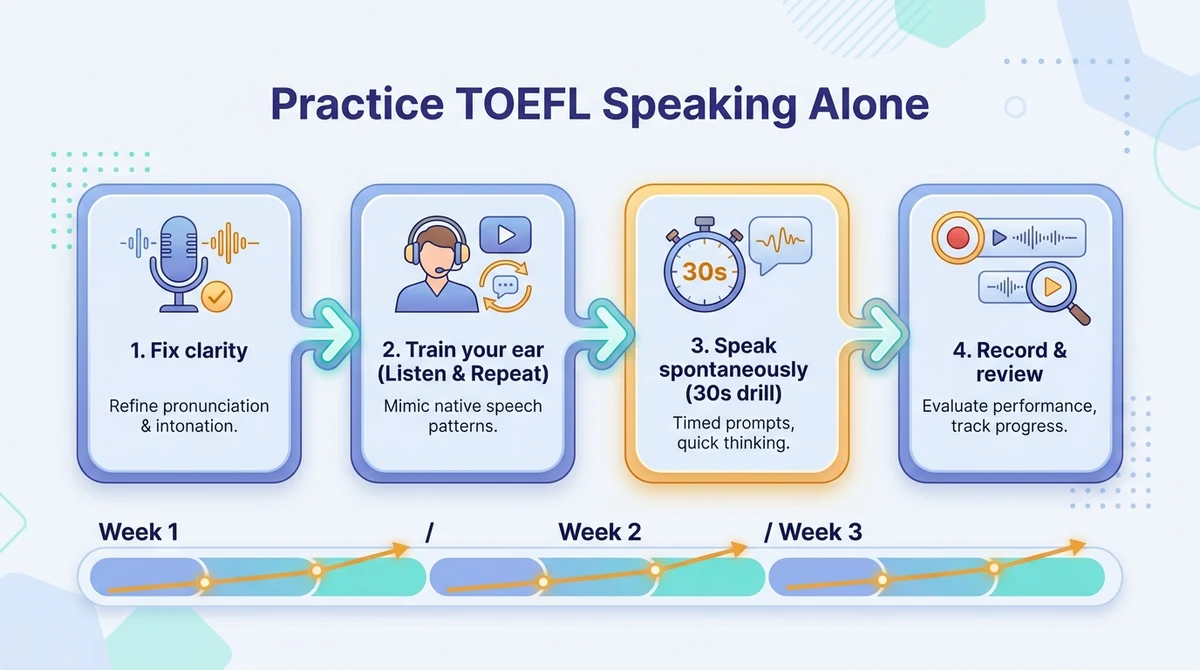
Step 1: Fix your baseline clarity first
Before you worry about content, worry about being understood. Both new tasks reward clear, natural speech, and Listen and Repeat is entirely about reproduction accuracy.
Spend your first week just cleaning up sound. Run daily drills in Pronunciation Studio, find your two or three weakest sounds, and drill them until they stop tripping you up. This is the foundation everything else sits on. There is no point polishing your interview answers if the examiner cannot cleanly understand your consonants.
Step 2: Build your ear with listen-and-repeat reps
Listen and Repeat is not really a speaking task. It is a listening-and-reproducing task. You cannot repeat what you did not catch.
Practice like this. Play a short English sentence, a podcast line, an audio clip, anything natural. Repeat it out loud immediately, matching the rhythm and stress, not just the words. Record yourself and compare. Then repeat with a new sentence, eight to ten times.
Start with slow, clear audio and gradually move to faster, more natural speech. Your goal is to catch the whole sentence on the first listen and reproduce its melody, not just its vocabulary. The rhythm carries as much meaning as the words, and the scoring hears it.
Step 3: Practice spontaneous speaking for the interview task
Because there is no prep time, the worst thing you can do is rehearse scripts. Instead, train the ability to start talking about anything, instantly.
The 30-second drill
Pick a random familiar topic, your weekend, your favorite food, your commute, and start speaking about it within three seconds. Talk for thirty seconds without stopping. Do not plan. Do not restart. Just keep going.
Do five of these a day. It feels awkward at first, and then, surprisingly fast, it does not. You are building the exact reflex the Take an Interview task measures: talking naturally under zero prep. The discomfort you feel in the first week is the skill being built, so push through it.
The AI Tutor and the TOEFL speaking tools can generate fresh interview-style prompts and score your responses, so you are never stuck thinking up topics or wondering how you did.
Step 4: Record, review, repeat
Self-study lives and dies on honest feedback. Since you do not have a tutor, your recordings are your tutor.
Every day, record at least a few responses and listen back for three things. First, clarity: could a stranger understand every word? Second, flow: did you hesitate, restart, or trail off? Third, naturalness: did it sound like a person talking, or a robot reciting?
Instant AI scoring speeds this up enormously. Instead of guessing, you get an objective read on clarity and fluency the moment you finish, which keeps you honest about what is actually improving.
A simple weekly plan
Here is how to put it together without burning out.
In week one, focus on pronunciation cleanup plus daily listen-and-repeat. In week two, keep the listen-and-repeat work and add the thirty-second spontaneous drill. From week three onward, do full mock reps of both tasks, recorded and reviewed daily.
Twenty focused minutes a day beats a three-hour cram session once a week, every time. The reason is simple: speaking is a physical, reflexive skill, and reflexes are built by frequent repetition, not by occasional marathons.
How to run your own mock test
Once the four steps feel familiar, put them together into a self-made mock test, because performing under mild pressure is different from practicing in comfort. You do not need special software. Set a timer for eight minutes, line up a few listen-and-repeat sentences and a couple of interview-style prompts, and run the whole thing start to finish without pausing.
The point of the mock is not to score yourself harshly. It is to notice what falls apart under time pressure. Maybe your clarity is fine in slow practice but slips when you are rushing. Maybe you freeze for two seconds before the interview prompts. Those cracks are gold, because they tell you exactly what to drill next. A skill that only works when you are relaxed is not yet reliable, and test day is not a relaxed environment.
Do one full mock a week. Between mocks, spend your daily practice fixing whatever the last mock exposed. That rhythm, weekly mock and daily targeted repair, is how self-study students close the gap on people paying for tutors. The tutor is not magic; the structure is, and you can build that structure yourself with a timer and a little honesty.
Staying motivated without a teacher
The hardest part of solo prep is not the practice, it is showing up when nobody is expecting you. A tutor creates accountability by putting a session on your calendar and waiting for you to arrive. Without one, you have to build that structure yourself, and it is worth doing deliberately rather than hoping motivation carries you.
A few things help. Keep your sessions short and fixed, twenty minutes at the same time each day, so the decision is already made before you have a chance to talk yourself out of it. Track your streak somewhere visible so skipping feels like breaking something. And save your recordings, because listening to a clip from three weeks ago next to today's is the most motivating proof that this is working.
Progress you can hear is far more convincing than progress you merely hope for, and it is usually the thing that keeps solo learners going all the way to test day. On the hard days, when you cannot feel yourself improving, an old recording is the honest witness that says, look how far you have already come.
You can absolutely do this alone
The 2026 format actually rewards the kind of practice that works well solo: clear sounds, a trained ear, and the confidence to speak without a script. None of that requires a tutor sitting next to you. It requires showing up daily, recording yourself honestly, and letting fast feedback tell you what to fix next.
Stay consistent, keep recording yourself, and let instant feedback stand in for the tutor. Do that for a few weeks and you will walk into the test speaking like someone who has already had this conversation a hundred times, because you will have. That quiet confidence, built one honest rep at a time, is exactly what carries a solo student through test day.
Should I use response templates for the 2026 TOEFL?
No. The new tasks have no prep time and reward natural speech, so memorized templates cost you seconds and sound rehearsed. Train spontaneity instead.
Continue Within This Cluster
Cluster guide
TOEFL Speaking Practice Guide for March 2026This guide explains toefl speaking practice with current March 2026 context, targeted practice ideas, and direct next steps inside EnglishPrepAI.
Keep Practicing
Official and Authoritative Sources
Share this article
Copy the canonical link or continue with the next guided practice step.
FAQ
How much daily practice do I need?
About twenty focused minutes a day is enough for steady progress. Consistency matters more than session length.
What should I practice first?
Baseline clarity. Spend your first week cleaning up your two or three weakest sounds before worrying about content.
How do I practice Listen and Repeat alone?
Play a short natural sentence, repeat it immediately while matching the rhythm, record yourself, compare, and repeat with new sentences.
How do I train spontaneous speaking?
Use the thirty-second drill: pick a random familiar topic, start speaking within three seconds, and talk for thirty seconds without stopping.
How do I review without a tutor?
Record every response and listen for clarity, flow, and naturalness. Instant AI scoring gives you an objective read on clarity and fluency.
Related Articles

TOEFL Speaking Practice Guide for March 2026
This guide explains toefl speaking practice with current March 2026 context, targeted practice ideas, and direct next steps inside EnglishPrepAI.
Best TOEFL Speaking Templates for the 2026 Format
This guide explains toefl speaking templates with current March 2026 context, targeted practice ideas, and direct next steps inside EnglishPrepAI.

TOEFL Speaking Time Management for the 2026 Format
This guide explains toefl speaking time management with current March 2026 context, targeted practice ideas, and direct next steps inside EnglishPrepAI.