5 Surprising Truths About English Proficiency Exams That Most Students Don't Know
Beyond the textbooks: discover the hidden strategies, technical tricks, and exam psychology that can transform your Cambridge B1 PET or Pearson PTE preparation and boost your score.
Direct Answer
What surprising exam strategy truths help students perform better on English proficiency tests?
The best next step for english proficiency exam strategies is to keep this legacy strategy, practice it inside EnglishPrepAI with one focused tool, and review the result right away so the advice becomes a repeatable routine instead of passive reading before your next exam milestone.
Collects overlooked exam psychology and technical habits into one broad strategy article for students preparing across multiple tests.
If you're preparing for a high-stakes English exam like the Cambridge B1 Preliminary (PET) or the Pearson Test of English (PTE), your desk is probably covered in grammar guides and vocabulary lists. The stress is real, and the focus is intense. But what if I told you that some of the most critical factors for success aren't found in your textbooks? They're hidden in the very design and strategy of the exams themselves.
As an exam coach, I've seen countless students master the language but stumble on the test. Why? Because they treated the exam like a simple test of English, not as a complex game with its own set of rules, traps, and shortcuts. This article is here to change that. I'm going to pull back the curtain and reveal five of the most surprising and impactful truths about these tests that can transform your preparation and boost your score.
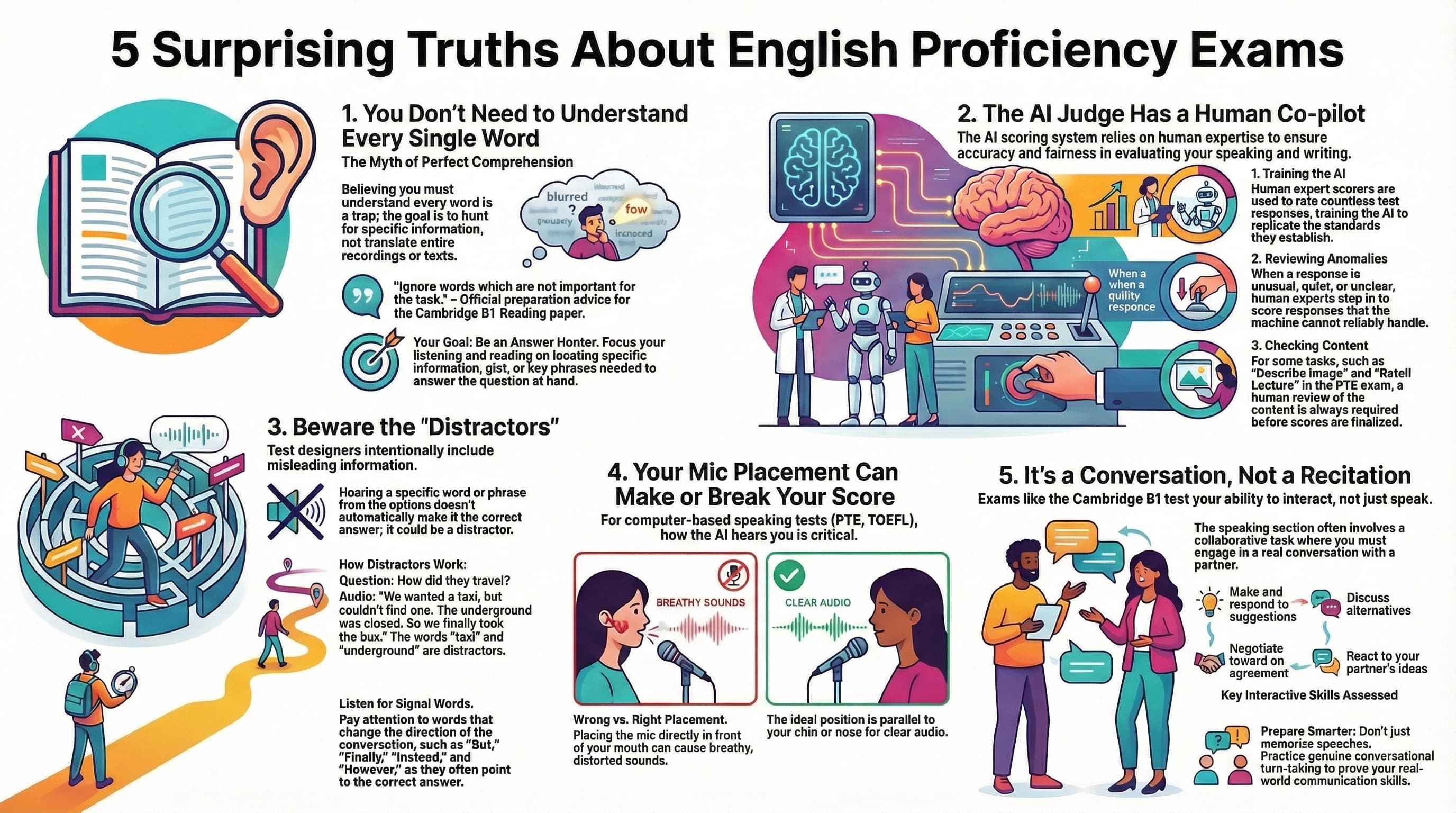
Takeaway 1: You Don't Need to Understand Every Single Word
One of the biggest sources of panic, especially in listening sections, is missing a word. The moment an unfamiliar term flies by, students freeze. They replay it in their minds, get flustered, and often miss the next part of the recording, convinced they've failed the question.
Here's the counter-intuitive secret: perfect comprehension is not the goal. In fact, chasing after every single word is a trap.
Don't worry; nobody in a listening exam understands everything. You don't need to understand everything to answer the questions correctly.
This is a powerful realization. It frees you from the pressure of perfection. Instead of trying to catch every word, your goal is to listen for the specific information needed to answer the question. This shift in mindset helps you stay calm, avoid panic, and focus your energy on hunting for the answer, not translating the entire recording.
Takeaway 2: The AI Judge Has a Human Co-pilot
With the rise of computer-based exams like the PTE Academic, many students believe their speaking and writing responses are scored exclusively by an impersonal Artificial Intelligence. It's a common assumption that a machine makes the final call on everything.
But here's the surprising truth: human experts are still a crucial part of the process. While AI handles a lot of the scoring, it doesn't work alone. These human experts have very specific and important roles:
- They are the ones who train the AI scoring engines, teaching the machine what a good response looks like.
- They step in to score "anomalies"—unusual responses that the machine cannot reliably evaluate.
- Most importantly, for certain speaking and writing tasks, there is always a human review of the content before the final scores are released.
Takeaway 3: Beware the Distractors
Test designers intentionally include wrong answers, known as distractors, that are designed to mislead you. Knowing that changes how you listen and read under pressure.
Takeaway 4: Your Mic Placement Matters
In computer-based speaking tests, you can have strong pronunciation but still lose points if your microphone placement makes the recording unclear.
Takeaway 5: Some Exams Test Real Conversation
Many speaking tests reward your ability to react naturally, negotiate ideas, and sustain a real exchange—not just deliver a memorized monologue.
It's Not Just What You Know, It's How You Play the Game
Success in a high-level English exam requires more than grammar and vocabulary. It also requires strategy, attention to technical details, and a better understanding of what the test is really measuring.
Ready to practice with AI-powered feedback? Start your free practice and experience intelligent preparation that goes beyond textbooks.
How should you act on english proficiency exam strategies?
Use english proficiency exam strategies advice inside one focused EnglishPrepAI practice cycle, review the result, and repeat the same skill until the improvement is consistent under timing pressure.
Continue Within This Cluster
Keep Practicing
Official and Authoritative Sources
Share this article
Copy the canonical link or continue with the next guided practice step.
FAQ
Who should read this guide about english proficiency exam strategies?
This article is for learners who want clearer, more reliable progress with english proficiency exam strategies before they spend time or money on a high-stakes English exam.
What should I do after reading this english proficiency exam strategies article?
Turn one idea from the article into a short timed practice session, then review the result immediately so the advice becomes a repeatable habit instead of passive reading.
How does EnglishPrepAI support english proficiency exam strategies?
EnglishPrepAI connects english proficiency exam strategies guidance to practice tools, AI feedback, and visible progress tracking so you can study with a tighter feedback loop.
Why keep this english proficiency exam strategies guide live?
This preserved article still targets an existing search need and keeps a stable URL live while EnglishPrepAI routes readers toward the most current tools and product flows.
How should I pair this legacy guide with current practice?
Read the main idea, choose one linked EnglishPrepAI practice route, complete one short drill, and compare the result against the article's core recommendation before moving on.
Related Articles
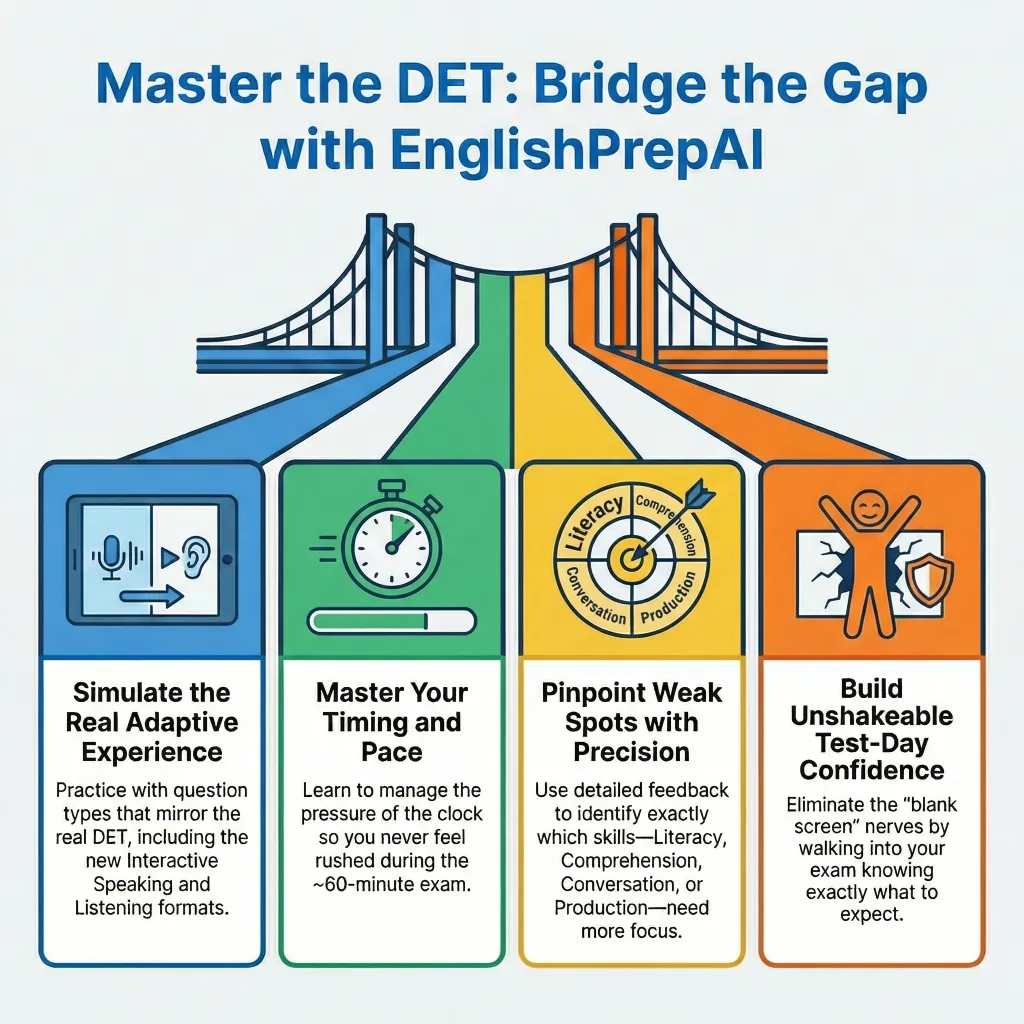
The Duolingo English Test Has Changed. Are You Ready?
You've studied the vocabulary and practiced your grammar. But are you ready for the logistics of the Duolingo English Test? Learn about the new secondary camera requirement and how EnglishPrepAI mock tests can help you prepare.

Your AI Coach for Smarter TOEFL Prep — Not Just Practice, Progress
The way students prepare for the TOEFL has changed forever. With TOEFL AI, you don't just study — you train intelligently. Instead of endless guessing games, our AI pinpoints exactly what's holding back your score.

New: Collective Reports Turn Your Practice Into a CEFR Score
Collective Reports pull all your practice into one CEFR-aligned score, so you finally know where your English stands and what to do next.